要点(約30秒)
- 1987 is Ding-mao: the fourth stem on the fourth branch, the fourth term of the sixty, and the branch feeds the stem, which is why the animal is a Fire Rabbit. The classical six-harmony tables pair Mao, the Rabbit, with Xu, the Dog; the clash table sets it against You, the Rooster, and its three-harmony ring is Hai–Mao–Wei — the Rabbit with the Pig and the Goat.
- The lunar year gets its sixth month twice. A leap sixth month runs 26 July to 23 August, twenty-nine days, and the ordinary sixth month keeps the thirty days before it.
- That insertion is not a choice: the national standard makes the first month with no mid-month term the leap one, and in 1987 the Great Heat falls inside the ordinary sixth while the End of Heat lands on the first day of the seventh.
- The lunar year is 384 days and thirteen months long, yet a chart still has twelve months, because month pillars are cut by the twelve sectional terms and not by the new moons.
- The first twenty-eight days of 1987 are the Tiger under both conventions; the dispute covers exactly six days, 29 January to 3 February.
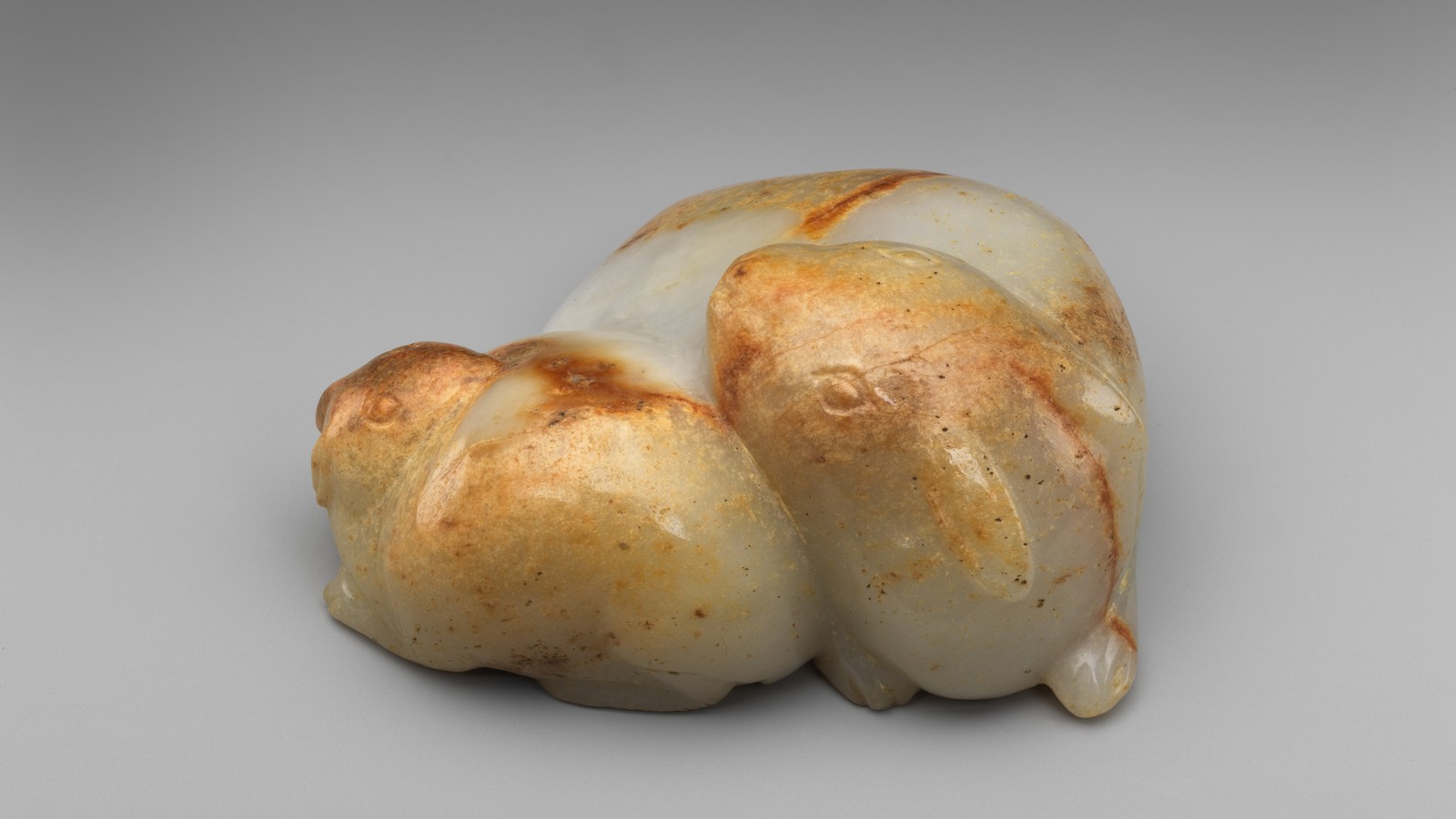
Ding-mao: the Fire Rabbit, fourth on both lists
The year 1987 is written 丁卯 (Ding-mao). Ding is the fourth of the ten heavenly stems and Mao the fourth of the twelve earthly branches, which makes the pair the fourth of the sixty terms.
The count opens with ten terms that stay in step: Jia-zi, Yi-chou, Bing-yin, Ding-mao, and on to Gui-you, the n-th stem riding the n-th branch each time. After the tenth the stems run out and start again while the branches keep going, and that alignment never comes back inside the cycle. Ding-mao is the fourth of the ten terms where the two rows still line up.
Ding carries fire and Mao carries wood, and in the five-phase cycle wood feeds fire: the branch supplies what the stem burns. The element word in front of the animal is taken from the stem, so 1987 is a Fire Rabbit — a rabbit with fire in front of it, not a fire that turns into a rabbit.
Two properties of the branch are worth keeping for later. Mao is where the wood ring 亥卯未 — Pig, Rabbit, Goat — reaches full strength: of the three branches in that ring it is the one at the peak, neither the one that gives the phase birth nor the one that stores it. And it hides exactly one stem, Yi, with nothing mixed in; only three of the twelve branches are like that, and Mao is one of them, alongside Zi and You.
The pair comes back every sixty years: 1927, 1987, 2047. Everything below concerns the second of the three.
1987 Compatibility: Six Harmony, Clash and Trine
The year gives one branch and nothing else — 卯 Mao, the Rabbit. The three relations below follow from that branch alone: they hold for every birth whose year branch is 卯, and they do not depend on the month, the day or the hour.
| Relation | Branch | Animal |
|---|---|---|
| Six harmony (六合) | 戌 Xu | Dog |
| Clash (相冲) | 酉 You | Rooster |
| Three harmony (三合) | 亥 and 未 | Pig, Goat |
A chart reads the four branches against each other, not the year branch on its own. The 144-pair table has every pair.
A year that gets its sixth month twice
Open the Observatory's conversion table for 1987 and one label appears twice. The line for 26 June reads "6th Lunar month". The line for 26 July reads "6th Lunar month" again. On 24 August the count resumes with "7th Lunar month".
Two months claim the same number. The first, 26 June to 25 July, runs thirty days. The second, 26 July to 23 August, runs twenty-nine, and it is the leap sixth month — the one the Chinese table marks 閏六月.
The two of them side by side, with the mid-month term each one holds:
| Month | First day | Last day | Mid-month term inside it |
|---|---|---|---|
| 6th month (30 days) | 26 June | 25 July | 大暑 (Great Heat), 23 July |
| Leap 6th month (29 days) | 26 July | 23 August | none |
One month holds a mid-month term and the other holds nothing. That single difference is what decides which of the two is the copy, and it is settled below.
The extra month is what makes this lunar year long. Counted from Lunar New Year's Day to the day before the next one, the Ding-mao year runs from 29 January 1987 to 16 February 1988: 384 days, thirteen months, seven of them thirty-day months and six of them twenty-nine.
A chart, though, still has twelve months. The month pillar is set by the twelve sectional terms — Li Chun, Jing Zhe, Qing Ming and the rest — and not by the new moons, so a month that exists only to correct the calendar never gets a pillar of its own. In 1987 the twelve run from Ren-yin, which opens at Li Chun on 4 February, to Gui-chou, which opens at Minor Cold on 6 January 1988.
Thirteen lunar months, twelve pillars. The calendar repeats itself; the chart does not.
Why the extra month has to land there
A leap month is not placed by preference. GB/T 33661-2017, the national standard for compiling the calendar, drafted by the Purple Mountain Observatory, fixes it in two clauses. The lunar month that contains the winter solstice is the eleventh month. And if thirteen months lie between one eleventh month and the next, the first of those months that contains no mid-month term becomes the leap month.
Run the rule over 1987 and it picks the month between 26 July and 23 August. The eleventh months on either side open on 2 December 1986 and 21 December 1987, and each of them contains the solstice; thirteen months sit in between; and walking them one by one, exactly one is empty of mid-month terms.
The mechanism is visible in two dates. The term Great Heat falls on 23 July, inside the ordinary sixth month, which runs to the twenty-fifth. The term End of Heat falls on 24 August, which is the first day of the seventh month. The month in between catches neither of them — and a month with nothing in its middle is precisely the one the rule doubles.
The Ming compendium says the same thing from the other side. 《三命通会·論四時節氣》 divides the twenty-four terms into the sectional ones that open a month and the mid-month ones, naming them month by month: 「六月節小暑,六月中大暑」 — the sixth month opens with Minor Heat and its middle belongs to Great Heat. A month is expected to hold a term in its middle; the leap month is the one that cannot.
The arithmetic behind it is small and worth doing once. Twelve lunar months come to about 354 days; the tropical year is 365.2422. The shortfall is close to eleven days a year, and left alone the new year would walk backwards through the seasons. The observatory's own note gives the fix as seven leap years in every nineteen, which brings the average back into line. The same note explains why leap months crowd into summer: between the summer solstice and Great Heat the earth is near aphelion and moves slowest, so the gap between mid-month terms stretches past thirty-one days and an empty month becomes likely. Across the ninety lunar years from 1940 to 2029 there are thirty-three leap years, and nineteen of them put the leap in the fourth, fifth or sixth month.
Which still leaves the leap sixth month uncommon rather than rare. It happens six times in those ninety years: 1941, 1960, 1979, 1987, 2017 and 2025. 1987 is the fourth of the six.
One consequence runs straight into the following year. Because the extra month makes this lunar year 384 days long, the next Lunar New Year lands on 17 February 1988: nineteen days later than a 365-day spacing would have put it, and, unlike 1987, after Li Chun on 4 February. The two lines therefore swap order from one year to the next. 1987 belongs to the standard for six days before the chart follows; 1988 belongs to the chart for thirteen days before the standard follows.
29 January against 4 February
A zodiac year does not begin on 1 January, and the day it does begin on has no single answer. China's national standard for the calendar, GB/T 33661-2017, drafted by the Purple Mountain Observatory of the Chinese Academy of Sciences, starts the lunar year at the first month, and the animal year shares that reference: the animal changes on Lunar New Year's Day. Chart-reading changes the sexagenary year at Li Chun, the solar term that opens spring.
In 1987 the two lines fall 6 days apart, and this year Lunar New Year comes first: Li Chun is 4 February and Lunar New Year's Day is 29 January. That means the national standard changes the animal 6 days before chart-reading does.
Chinese Zodiac Year Boundary lists both lines for every year from 1940 to 2030, with the gap in days for each.
The six days that answer twice
7 calendar days in 1987 sit on or between the two lines, and 6 of them are read differently depending on which convention is in play.
| Date in 1987 | Under the national standard | Under chart-reading |
|---|---|---|
| 29 January – 3 February (6 days) | Rabbit | Tiger |
| 4 February | Rabbit | Rabbit |
The 6 days from 29 January are the contested ones. The standard moved the year on 29 January, at Lunar New Year's Day, so it reads those 6 days as Rabbit; chart-reading waits for Li Chun on 4 February, and until then they stay in 1986, the year of the Tiger. On 4 February the two lines meet: that day is Li Chun, and chart-reading has changed to the Rabbit year as well. From then on both conventions read the same animal.
A birth on the boundary day itself is the harder case, because Li Chun is a moment rather than a day. The page linked above explains why it gives days and not times.
The first twenty-eight days of 1987 are the Tiger
Ask what animal 1987 is and the answer has a date inside it. The year opens inside the previous lunar year: Bing-yin, the Tiger, ran until 28 January 1987. The national standard hands the year to the Rabbit on 29 January, at Lunar New Year. Chart-reading waits for Li Chun on 4 February.
So 1987 has three zones and only the middle one is contested. From 1 to 28 January both conventions say Tiger — a birthday in those four weeks belongs to a Tiger year, whatever the calendar year on the certificate says. From 29 January to 3 February the standard says Rabbit and a chart says Tiger: six days, and that is the whole width of the dispute. From 4 February onward both say Rabbit.
That is why a year page cannot answer the question in one word. The animal is a label tied to an interval, and in 1987 the interval has a fork near its start.
What the label carries is worth stating plainly, because most writing about animal years implies more. 1987 identifies a birth year, and together with the stem and branch a position in a sixty-term count that repeats without end. It says nothing about how the year went for anyone, and nothing about how a person born in it will fare; there is no body of evidence behind a forecast of that kind, so this page does not print one. Dates and labels can be checked. The rest would be invention.
干支と五行を読む——無料How to check the 1987 dates
The Observatory publishes one plain-text table per year, and the file for 1987 is T1987e.txt. Each line carries a date, the lunar month whenever a month opens on that day, the weekday, and any solar term falling on it. Four lines settle everything on this page: 29 January opens the first lunar month; 4 February carries Spring Commences; 26 June and 26 July both carry "6th Lunar month"; and 24 August opens the seventh month with End of Heat on the same line.
Watch the leap month if you are reading the English file. The Chinese table writes 閏六月 on 26 July; the English table repeats the ordinary label and does not add the word leap, so the two rows look the same apart from the date. Counting months in English, the leap month is the second of two identical labels, and the way to be sure is that the row after it opens the seventh month.
No clock time is given for either boundary on this page, and that is deliberate: a solar term falls on a day, and the same authoritative source does not carry the hour across the whole span these pages cover, so the page gives the day rather than filling the hour in from a different kind of source. A birth on one of the two boundary days is the one case this page cannot settle, and it says so instead of guessing.
Where the 1987 dates come from
Li Chun, Lunar New Year's Day, the start of the 1987 lunar year and all thirteen of its months are read from the Hong Kong Observatory's Gregorian-Lunar Calendar Conversion Table for 1987 and for the years on either side of it; the 384-day figure is that table's own month lengths added together, not an estimate. The insertion rule is clause 4.4 of GB/T 33661-2017, 《农历的编算和颁行》, published in full by the national standards service. The nineteen-year figure and the reason leap months cluster in summer come from the Purple Mountain Observatory's own answers to calendar questions.
The distinction between the sectional terms that open a month and the mid-month terms comes from volume two of the Ming compendium 三命通会, chapter 論四時節氣; the wood ring 亥卯未 comes from 論支元三合 in the same volume. Chinese Zodiac Year Boundary lists both year edges for every year from 1940 to 2030 with the gap in days, and Rabbit covers the animal on its own. How we cite sets out how sources are chosen and dated here.
The full table behind this page — 1901 to 2100 — is published as a free dataset: chinese zodiac year boundaries.
GPTbazi is a personality map for entertainment and self-reflection. It is not medical, legal, financial, or psychological advice, and it is not a prediction of events. Calendar dates and solar-term boundaries are astronomical and official calendar facts, not readings of a person.
出典
- Hong Kong Observatory — Gregorian-Lunar Calendar Conversion Table for 1987 (the file this page reads)
- Hong Kong Observatory — Gregorian-Lunar Calendar Conversion Table (year index)
- GB/T 33661-2017 《农历的编算和颁行》 — national standard record (drafted by the Purple Mountain Observatory; in force 1 September 2017)
- Guangming Online (光明网) — what GB/T 33661-2017 fixes as the start and end of a zodiac year
- GB/T 33661-2017 《农历的编算和颁行》 — full text on the national standards service (clause 4.3 makes the month containing the winter solstice the eleventh; clause 4.4 makes the first month without a mid-month term the leap month)
- Purple Mountain Observatory, Chinese Academy of Sciences — 历书科普问题解答, on the nineteen-year cycle, the 354-day lunar year against 365.2422, and why leap months cluster in summer
- 《三命通会·卷二·論四時節氣》 — the chapter that splits the twenty-four solar terms into the sectional ones that open a month and the mid-month ones (「六月節小暑,六月中大暑」;「白露八月節,寒露九月節」)
- 《三命通会·卷二·論支元三合》 — the chapter that names the four three-branch rings (Shen-Zi-Chen as the water ring) and says a ring needs all three
- GPTbazi — BaZi methodology and the solar-term boundary
- GPTbazi — how sources are chosen and dated