要点(約30秒)
- 1985 is Yi-chou: the second stem and the second branch, one of the two stems that carry Wood, which is what makes it a Wood Ox.
- Three rules, not 144 judgements, generate a compatibility chart: clash, six-harmony and the three-harmony rings — and for the Ox branch they produce exactly four partners, the Rat, the Goat, the Snake and the Rooster.
- The Ox year has two beginnings. Chart-reading starts it on 4 February 1985, at Li Chun; the national standard starts it on 20 February, at Lunar New Year.
- The Ox's own element is earth, and the ring it belongs to is the metal ring, where it is the branch that stores the phase. It is one of four storehouse branches with Chen, Wei and Xu.
- Sixteen days is the widest gap in the ninety-one years from 1940 to 2030, and 1985 is the only year at that width; it is also the latest Lunar New Year's Day in the span.
Yi-chou: the Wood Ox, second term of the cycle
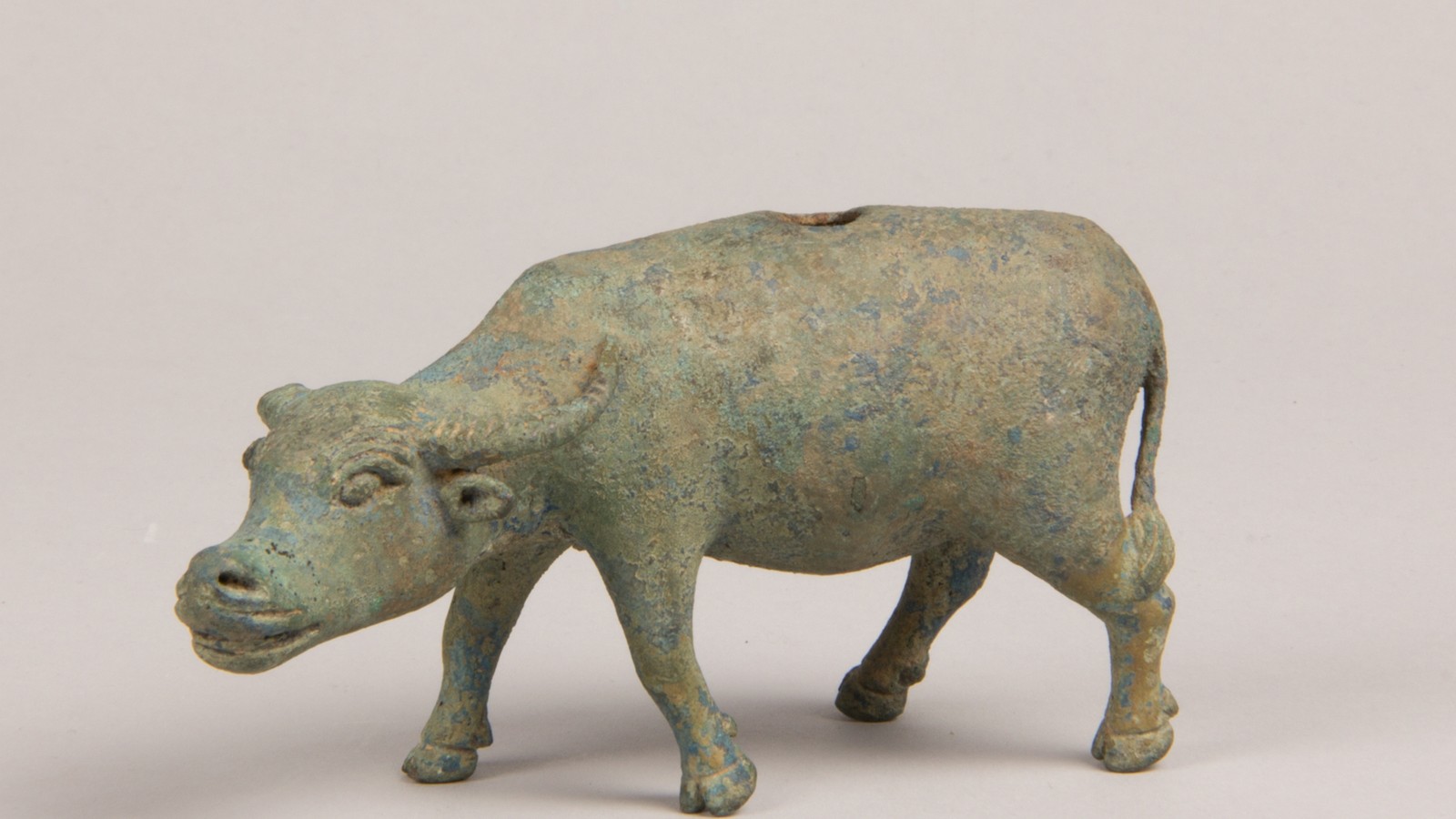
The year 1985 carries the Ox, and the word in front of it is Wood. The sexagenary count — sixty terms, each one pairing a heavenly stem with an earthly branch — writes the year as 乙丑 (Yi-chou). Yi is the second of the ten stems and one of the two that carry Wood; Chou is the second of the twelve branches, the Ox.
The count has no starting point inside the century, only a fixed order. Counting from 1984, which is Jia-zi, the first term, gives 1984 Jia-zi and 1985 Yi-chou. The stem turns every ten years and the animal every twelve, so this exact pairing is the rarer of the two: the Wood Ox comes back once in sixty years, in 1925, 1985 and 2045.
Being a Wood Ox fixes the element, not the edges of the year. The year has two edges and they come from two different rules.
Under China's national standard for the calendar, the animal changes on Lunar New Year's Day, which in 1985 is 20 February; the Rat held the year until the nineteenth. Chart-reading changes the year at Li Chun, which in 1985 falls on 4 February. The two rules also give the year two different lengths: the Ox year is 354 days measured from Lunar New Year to Lunar New Year, and 365 measured from Li Chun to Li Chun. Both figures are correct inside their own convention.
The next section gives the branch's relations. Everything after it turns on the sixteen days between 4 February and 20 February, the only stretch of 1985 in which the two conventions disagree about which animal a birthday carries.
1985 Compatibility: Six Harmony, Clash and Trine
The year gives one branch and nothing else — 丑 Chou, the Ox. The three relations below follow from that branch alone: they hold for every birth whose year branch is 丑, and they do not depend on the month, the day or the hour.
| Relation | Branch | Animal |
|---|---|---|
| Six harmony (六合) | 子 Zi | Rat |
| Clash (相冲) | 未 Wei | Goat |
| Three harmony (三合) | 巳 and 酉 | Snake, Rooster |
A chart reads the four branches against each other, not the year branch on its own. The 144-pair table has every pair.
One branch, four partners, three rules
A compatibility chart for the twelve animals looks like a table of 144 separate judgements. It is not. Three rules generate it, and each rule is an arithmetic on branch positions — counting from 1 at Zi, the Rat, to 12 at Hai, the Pig.
The clash rule is the simplest. A branch clashes with the one six places along: 1 with 7, 2 with 8, right through to 6 with 12. Six pairs in total, every one of them the same distance apart, which is why a clash chart falls on a single clean diagonal.
The six-harmony rule is built differently. The Ming-dynasty compendium 《三命通会》 sets it out as a sum of the yin and yang numbers of the two branches: they make nine. Put into positions on the ring, that means each branch pairs with the branch whose number makes fifteen with it — with one exception the chapter states on its own, the first two branches, which it gives as three. The upshot is that the six harmony pairs sit at gaps of 1, 9, 7, 5 and 3 places. No two of them are the same distance apart.
The three-harmony rule is the only one that takes three branches. Three branches four places apart form a ring — Shen, Zi and Chen; Si, You and Chou; and two more like them. The chapter is explicit that a ring with one branch missing is not a ring, and that earth has no ring of its own.
For the Ox branch, those three rules produce exactly four partners:
| The Ox pairs with | Under which rule | Where the rule puts it |
|---|---|---|
| 未 — Goat | clash | 2 + 6 = 8, six places along the ring |
| 子 — Rat | six-harmony | 1 + 2 = 3, the pair the classic states on its own |
| 巳 — Snake | three-harmony ring | one of three branches set four places apart |
| 酉 — Rooster | three-harmony ring | the same ring; a ring needs all three |
Four of the eleven other animals. The other seven carry none of these three relations with the Ox. That is the sense in which the wide compatibility table is generated rather than filled in by hand: 144 cells are not 144 judgements, they are three rules applied 144 times.
The Ox is earth that stores metal
Chou is a branch of earth; its own element is earth. The ring it belongs to, though, is the metal ring — Si, You and Chou, the Snake, the Rooster and the Ox. The two classifications do not collide, because they answer different questions. One says what the branch is; the other says which phase its ring carries.
The compendium names the three positions inside a ring in order: the branch that gives the phase birth, the branch where it peaks, and the branch where it is put away. Si gives metal its birth, You is metal at full strength, and Chou stores it. Chou is a branch whose own nature is earth, holding a phase whose nature is metal.
Chou is one of the four storehouse branches, with Chen, Wei and Xu. The chapter is careful about what that means for earth. It notes that the five phases are not counted as forming an earth ring, because the other four all need earth to complete theirs and everything is stored in earth — then adds that if all four of Chen, Xu, Chou and Wei appear together, they are read as an earth configuration in their own right.
So a single branch carries three labels at once, and none of them cancels another: earth by its own nature, the storehouse of the metal ring, and one quarter of the earth configuration that shows up only when all four storehouses are present. A year written 乙丑 carries all three.
4 February against 20 February
A zodiac year does not begin on 1 January, and the day it does begin on has no single answer. China's national standard for the calendar, GB/T 33661-2017, drafted by the Purple Mountain Observatory of the Chinese Academy of Sciences, starts the lunar year at the first month, and the animal year shares that reference: the animal changes on Lunar New Year's Day. Chart-reading changes the sexagenary year at Li Chun, the solar term that opens spring.
In 1985 the two lines fall 16 days apart, and this year Li Chun comes first: Li Chun is 4 February and Lunar New Year's Day is 20 February. That means chart-reading changes the animal 16 days before the national standard does.
Chinese Zodiac Year Boundary lists both lines for every year from 1940 to 2030, with the gap in days for each.
Sixteen days split between two answers
17 calendar days in 1985 sit on or between the two lines, and 16 of them are read differently depending on which convention is in play.
| Date in 1985 | Under the national standard | Under chart-reading |
|---|---|---|
| 4 February – 19 February (16 days) | Rat | Ox |
| 20 February | Ox | Ox |
The 16 days from 4 February are the contested ones. The standard still counts them inside 1984, whose animal is the Rat, because Lunar New Year has not arrived; chart-reading has already changed the year at Li Chun on 4 February. On 20 February the two lines meet: that day is Lunar New Year's Day itself, the first day of the Ox year under the standard, and chart-reading has been there since Li Chun. From then on both conventions read the same animal.
A birth on the boundary day itself is the harder case, because Li Chun is a moment rather than a day. The page linked above explains why it gives days and not times.
The widest gap in ninety-one years
The distance between the two lines is not a fixed property of the year, and 1985 is the year that shows it. Across the ninety-one years from 1940 to 2030 the gap runs from 0 days to 16 — and 16 occurs once. 1985 is the only year of the whole span in which the two lines stand sixteen days apart. The next widest are 1996 and 2015, at fifteen days.
The sun is not the cause. Li Chun falls on 3, 4 or 5 February and then holds still for years at a stretch; in 1985 it is 4 February, exactly as in 1984, 1986 and 1987. The line that moves is the moon's. Lunar New Year's Day lands wherever the new moons put it, and in 1985 it lands on 20 February, the latest date it reaches anywhere between 1940 and 2030 — again, a date that occurs once in the span.
Sixteen days is what a Lunar New Year that waits until 20 February leaves behind it.
A sixteen-day gap means sixteen of the window's seventeen days are read two ways. For anyone born between 4 and 19 February 1985 that is the whole question: the standard says Rat, a chart says Ox, and neither of them is a mistake.
It also makes 1985 the widest window in this set of pages, which covers ten February birthdays from 1977 to 1989. The narrowest in the same set is two days. A birthday that falls in February is therefore not one question with one answer, but a question whose width changes from one year to the next.
干支と五行を読む——無料How to check the 1985 dates
The Observatory publishes one plain-text file per year, and the 1985 file is T1985e.txt, listed among its Gregorian-Lunar calendar conversion tables. Each line carries a date, the lunar month and day if that day opens a month, the weekday, and any solar term falling on it. Two lines settle the whole question: the one for 4 February 1985 carries "Spring Commences", which is Li Chun, the day chart-reading's line turns over, and the one for 20 February carries "1st Lunar month", the day the standard's line turns over.
Every date on this page is read from those lines and the ones between them; none comes from a secondary account. No clock time is given for either line, and that is deliberate: a term falls on a day and this page says which day, while the hour is not carried by the same authoritative source across the whole span, so it is left out rather than filled in from another kind of source. A birth on one of the two boundary days is the one case this page cannot settle, and it says so instead of guessing.
Where the 1985 dates come from
Li Chun, Lunar New Year's Day and the lengths of the lunar years quoted here are read from the Hong Kong Observatory's Gregorian-Lunar Calendar Conversion Table for 1985 and for the years around it; the comparison against the other ninety years uses the same series, 1940 to 2030. The standard behind the first of the two lines is GB/T 33661-2017, drafted by the Purple Mountain Observatory of the Chinese Academy of Sciences. The three compatibility rules come from volume two of the Ming-dynasty compendium 三命通会.
Chinese Zodiac Year Boundary lists both lines for every year from 1940 to 2030 with the gap in days for each, and it is the source of the ninety-one-year comparison above. Chinese Zodiac Compatibility is the table the three rules generate. How we cite sets out how sources are chosen and dated on this site.
The full table behind this page — 1901 to 2100 — is published as a free dataset: chinese zodiac year boundaries.
GPTbazi is a personality map for entertainment and self-reflection. It is not medical, legal, financial, or psychological advice, and it is not a prediction of events. Calendar dates and solar-term boundaries are astronomical and official calendar facts, not readings of a person.
出典
- Hong Kong Observatory — Gregorian-Lunar Calendar Conversion Table for 1985 (the file this page reads)
- Hong Kong Observatory — Gregorian-Lunar Calendar Conversion Table (year index)
- GB/T 33661-2017 《农历的编算和颁行》 — national standard record (drafted by the Purple Mountain Observatory; in force 1 September 2017)
- Guangming Online (光明网) — what GB/T 33661-2017 fixes as the start and end of a zodiac year
- 《三命通会·卷二·論衝擊》 — the Ming-dynasty chapter on clashes, which states the rule the clash chart falls on(「地支取七位為沖…數中六則合,七則過」)
- 《三命通会·卷二·論支元六合》 — the chapter that sets out the six-harmony pairs as a sum of yin and yang numbers(「卯為四陽,戌是五陰,四五得九數」), and singles out the first pair, 子丑, at three
- 《三命通会·卷二·論支元三合》 — the chapter that names the four three-branch rings (巳酉丑 as the metal ring), insists a ring needs all three(「若三字缺一則化不成局」), and says earth forms no ring of its own but that the four storehouse branches 辰戌丑未 are read as one when they appear together
- GPTbazi — BaZi methodology and the solar-term boundary
- GPTbazi — how sources are chosen and dated