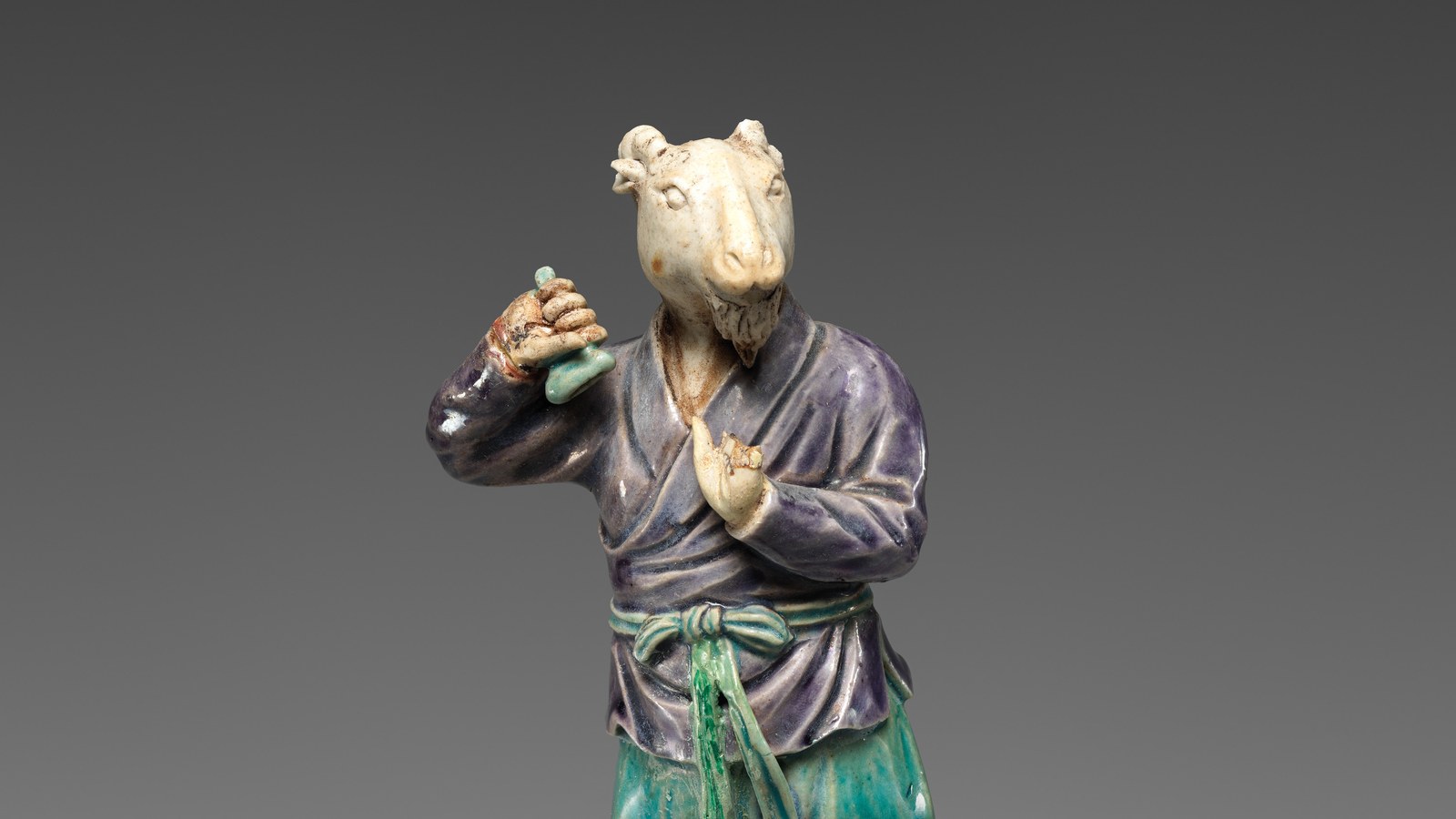
Key takeaways (~30 sec)
- 1979 is 己未, Ji-wei: the sixth heavenly stem over the eighth earthly branch, and term 56 of the sixty. The classical six-harmony tables pair Wei, the Goat, with Wu, the Horse; the clash table sets it against Chou, the Ox, and its three-harmony ring is Hai–Mao–Wei — the Goat with the Pig and the Rabbit.
- The Hong Kong Observatory's file for the year says the same thing in its first line — the pair, the animal and the year, on one row.
- 1978 is term 55, 1980 term 57, 1983 term 60 and 1984 term 1: seven years with no break at the sixtieth.
- 1979, 1984 and 1989 print the same twelve month pillars, because 甲 and 己 open the first month at the same stem.
- The Goat year runs 28 January 1979 to 15 February 1980 under the standard and 4 February 1979 to 4 February 1980 on a chart: one calendar week differs at the start, eleven days at the far end.
Ji-wei: a sixth stem over an eighth branch
1979 is written 己未 (Ji-wei). 己 is the sixth of the ten heavenly stems and 未 is the eighth of the twelve earthly branches, so the label is two ordinals stacked: one from each list. Neither half is decoration. The stem decides the element word that sits in front of the animal; the branch decides which animal it is.
The conversion table this page works from settles both questions in its first line, before any date appears. The English file is headed "Gregorian-Lunar Calendar Conversion Table of 1979 (Ji-wei – year of the Goat)", and the Chinese file for the same year opens 1979(己未-肖羊)年公曆與農曆日期對照表. Pair, animal, year — three things that normally need three sources, printed on one row.
Because the element word comes from the stem, a Goat year can carry any of the five, and the stem alone decides which. 己 is the earth one, so 1979 is an Earth Goat. That sentence is a statement about the stem and nothing more: it does not make the animal steadier or slower than a Fire Goat would be. The Goat page covers the animal itself, including the reason English writes it three different ways.
What the pair does not carry is a character. 己未 names a year the way an index names a chapter: it fixes where the year sits and what it is called, and it stops there. Claims about the sort of person born under it are a different business, and this page leaves them out.
1979 Compatibility: Six Harmony, Clash and Trine
The year gives one branch and nothing else — 未 Wei, the Goat. The three relations below follow from that branch alone: they hold for every birth whose year branch is 未, and they do not depend on the month, the day or the hour.
| Relation | Branch | Animal |
|---|---|---|
| Six harmony (六合) | 午 Wu | Horse |
| Clash (相冲) | 丑 Chou | Ox |
| Three harmony (三合) | 亥 and 卯 | Pig, Rabbit |
A chart reads the four branches against each other, not the year branch on its own. The 144-pair table has every pair.
Fifty-six, five years short of the restart
Position takes one line of arithmetic. Subtract 4 from the year, divide by 60, keep the remainder, add one. 1979 − 4 = 1975; 1975 = 32 × 60 + 55; so 1979 is term 56.
The neighbours hold up one at a time. 1978 is 戊午 (Wu-wu), term 55. 1980 is 庚申 (Geng-shen), term 57. 1982 is 壬戌 (Ren-xu), 59. 1983 is 癸亥 (Gui-hai), 60, the last term of a round. And 1984 is 甲子 (Jia-zi), term 1. Seven years, and the count walks from 55 to 1 without a stumble at the sixtieth.
So term 56 sits five places before the one term most people have heard of. The distance is worth stating exactly, because "five years before the cycle restarts" is the sort of phrase that suggests a pause. There is none: the count runs 56, 57, 58, 59, 60, 1 with no gap, and the year that lands on 1 is 1984. That page sets out why term 1 is a remainder rather than an event.
A second check needs no arithmetic at all. The Chinese heading of the same conversion table prints 己未 next to 肖羊 — the pair and the animal, side by side — so any source that hands 1979 a different pair is wrong on that point whatever else it gets right.
Three years here print the same month pillars
Month pillars use the same two lists, and their stems are not chosen freely: the stem of the year fixes the stem of the first month, and the remaining eleven follow in order. The Ming handbook puts the rule in verse, 甲己之年丙作首 — in a Jia year or a Ji year, Bing opens the first month — and the other four pairs fall out the same way: Yi and Geng open at Wu, Bing and Xin at Geng, Ding and Ren at Ren, Wu and Gui at Jia.
Ten stems, five openings. Two years five apart share a stem by construction, so they also share every month pillar of the year, whatever their branches and animals happen to be.
Three years with pages here are 1979 (己未), 1984 (甲子) and 1989 (己巳). Three different branches, three different positions in the sixty, and the same twelve month pillars from 丙寅 to 丁丑 — terms three through fourteen of the count, consecutive and unrepeated. It is one rule applied to one stem group, not a coincidence in the calendar.
It is also not a claim that the years resemble each other. The chain is a naming scheme cut by solar terms: the first month opens at Li Chun, which in 1979 is 4 February, the same date as in 1984, because the term cuts the month and the animal has no say in it.
28 January against 4 February
A zodiac year does not begin on 1 January, and the day it does begin on has no single answer. China's national standard for the calendar, GB/T 33661-2017, drafted by the Purple Mountain Observatory of the Chinese Academy of Sciences, starts the lunar year at the first month, and the animal year shares that reference: the animal changes on Lunar New Year's Day. Chart-reading changes the sexagenary year at Li Chun, the solar term that opens spring.
In 1979 the two lines fall 7 days apart, and this year Lunar New Year comes first: Li Chun is 4 February and Lunar New Year's Day is 28 January. That means the national standard changes the animal 7 days before chart-reading does.
Chinese Zodiac Year Boundary lists both lines for every year from 1940 to 2030, with the gap in days for each.
Seven days that answer twice
8 calendar days in 1979 sit on or between the two lines, and 7 of them are read differently depending on which convention is in play.
| Date in 1979 | Under the national standard | Under chart-reading |
|---|---|---|
| 28 January – 3 February (7 days) | Goat | Horse |
| 4 February | Goat | Goat |
The 7 days from 28 January are the contested ones. The standard moved the year on 28 January, at Lunar New Year's Day, so it reads those 7 days as Goat; chart-reading waits for Li Chun on 4 February, and until then they stay in 1978, the year of the Horse. On 4 February the two lines meet: that day is Li Chun, and chart-reading has changed to the Goat year as well. From then on both conventions read the same animal.
A birth on the boundary day itself is the harder case, because Li Chun is a moment rather than a day. The page linked above explains why it gives days and not times.
Where the Goat year begins, and where it stops
Ask which days are 1979's and both conventions answer with a range rather than a date — and the two ranges differ at both ends. Counting the first and last day in:
| Convention | The Goat's days | Length |
|---|---|---|
| National standard | 28 January 1979 to 15 February 1980 | 384 days |
| Chart-reading | 4 February 1979 to 4 February 1980 | 366 days |
The start is the week described above: seven contested days, running from a Sunday to a Saturday, a whole calendar week. The end is a separate difference, eleven days wide, and it lands in 1980: from 5 to 15 February 1980 the standard still reads Goat while a chart has already changed to the Monkey, because Li Chun 1980 falls on 5 February and Lunar New Year 1980 waits until the 16th. That tail is the subject of the 1980 page and is not settled here.
The two lengths come from two unrelated things. 384 is the lunar year that opened on 28 January 1979: thirteen months, one of them a second sixth month, which is what pushes the total past the usual 354 or 384. The 1987 page works through why a leap month lands where it does; here it only matters that the month exists. 366 is simply the distance from one Li Chun to the next, 4 February to 4 February with both days counted, and lunar months have nothing to do with it.
Read your sign and element — freeChecking the 1979 dates yourself
The Observatory publishes one plain-text file per year. T1979e.txt and T1979c.txt carry a line for every day: the Gregorian date, the lunar month whenever one opens that day, the weekday, and any solar term falling on it. Five lines settle the start and the shape of the year. 28 January opens the first lunar month. 4 February carries Spring Commences. 24 June and 24 July both open a sixth lunar month, which is how a thirteen-month year shows up in a table with no column for leap months. And the 1980 file opens the first month on 16 February, which is where this year's Goat days stop.
The position takes one line and no table: 1979 − 4 = 1975, which is thirty-two sixties plus fifty-five, so the term is 56. The two ranges take one more line each: 16 February 1980 minus 28 January 1979 is 384 days, and 5 February 1980 minus 4 February 1979 is 366.
Worth saying what the label is not, because most writing about animal years implies more. 己未 identifies a birth year and one place in a count that keeps running. It says nothing about how the year went for anyone, and nothing about how a person born in it will turn out; there is no body of evidence behind a claim of that kind, so this page leaves it out.
No clock time is given for either boundary, deliberately: a solar term falls on a day, and the same authoritative source does not carry the hour across the span these pages cover, so the page gives the day rather than filling the hour in from a different kind of source. A birth on one of the boundary days is the case this page cannot settle, and it says so instead of guessing.
Where the 1979 dates come from
Li Chun, Lunar New Year's Day and every lunar month start are read from the Hong Kong Observatory's Gregorian-Lunar Calendar Conversion Table for 1979 and for 1980, and the two headings quoted above are that table's own first lines. The 384-day and 366-day figures are differences between dates in those files, not estimates.
The rule that gives a Ji year its first month at Bing comes from 論遁月時 in volume two of the Ming compendium 三命通会. Chinese Zodiac Year Boundary lists both year edges for every year from 1940 to 2030 with the gap in days, and Goat covers the animal on its own. How we cite sets out how sources are chosen and dated here.
The full table behind this page — 1901 to 2100 — is published as a free dataset: chinese zodiac year boundaries.
GPTbazi is a personality map for entertainment and self-reflection. It is not medical, legal, financial, or psychological advice, and it is not a prediction of events. Calendar dates and solar-term boundaries are astronomical and official calendar facts, not readings of a person.
Sources
- Hong Kong Observatory — Gregorian-Lunar Calendar Conversion Table for 1979 (the file this page reads)
- Hong Kong Observatory — Gregorian-Lunar Calendar Conversion Table (year index)
- GB/T 33661-2017 《农历的编算和颁行》 — national standard record (drafted by the Purple Mountain Observatory; in force 1 September 2017)
- Guangming Online (光明网) — what GB/T 33661-2017 fixes as the start and end of a zodiac year
- Hong Kong Observatory — 1979 年公曆與農曆日期對照表 (the Chinese table whose heading prints 己未 next to 肖羊)
- Hong Kong Observatory — Gregorian-Lunar Calendar Conversion Table for 1980 (read for the Lunar New Year on 16 February, which closes this year's Goat days)
- 《三命通会·卷二·論遁月時》 — the chapter on deriving the month pillar from the year, whose song gives 戊 years their first month as Jia-yin (「戊癸何處起?甲寅之上好追求」)
- GPTbazi — BaZi methodology and the solar-term boundary
- GPTbazi — how sources are chosen and dated