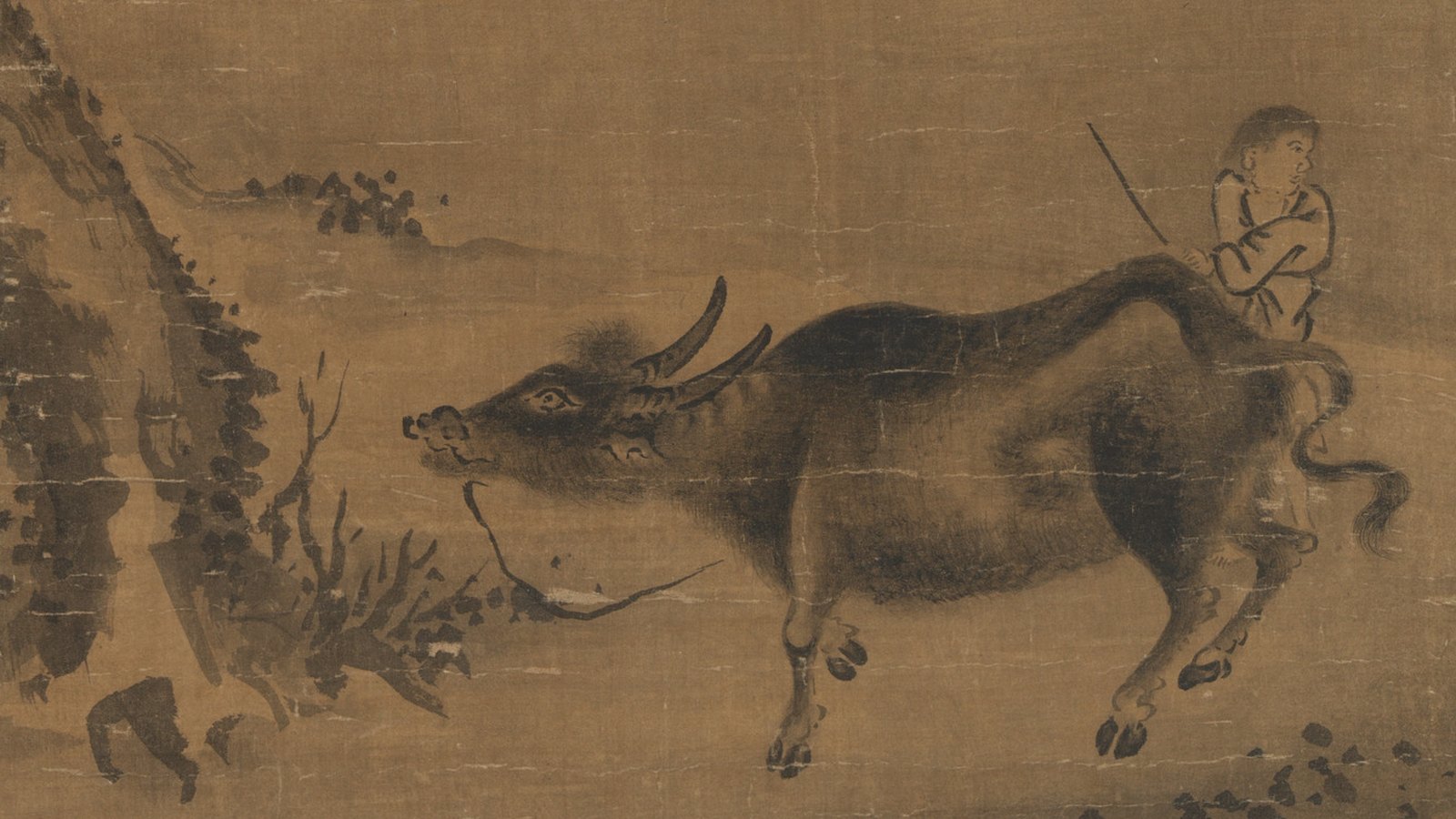
Key takeaways (~30 sec)
- Chou, the Ox, is the second of the twelve branches. The Ox's clash is the Goat, and the two are one of only two pairs in the whole table whose branches share a principal stem: 己, the yin earth, at twelve points out of twenty on both sides. Both of those pairs are clashes, so earth is the only element that clashes with itself twice. The classical tables pair Chou, the Ox, with Zi, the Rat, in six harmony; its three-harmony ring is Si–You–Chou — with the Snake and the Rooster; it clashes with Wei, the Goat, and is harmed by Wu, the Horse.
- Across the eleven Ox years from 1913 to 2033 the two new-year lines never land on the same date. 立春 comes first in six of them, the first lunar day in five, and 1985 is the widest at sixteen days. Those eleven years carry all five element forms, and every Ox year takes a yin stem.
- The Ox's row in the relation table names six branches but carries seven entries, because 未 is written down twice — once as the clash and once as a punishment. 丑 is not one of the four branches that punish themselves.
- Each one's closest ally is the other's enemy: 子 combines with the Ox and is the branch the Goat is harmed by, 午 combines with the Goat and is the branch that harms the Ox, and 子 and 午 clash with each other.
- The first solar term is called 打春, beating spring, and the name comes from an ox. A clay or paper ox is whipped at 立春, the Book of Rites has it as 出土牛,以送寒氣, and the commentary ties it to the Ox's own month: 月建丑.
The short answer
The Ox is the second of the twelve Chinese zodiac animals — 丑, the branch that runs from 01:00 to 03:00. Its years are 1913, 1925, 1937, 1949, 1961, 1973, 1985, 1997, 2009, 2021 and 2033. It clashes with the Goat, combines with the Rat, and is harmed by the Horse. Its row names six branches but carries seven entries, because the Goat is written down twice.
Two of the eleven Ox years are Earth Ox years: 1949 and 2009, both 己丑. The Chinese zodiac calculator will tell you which form yours is, and whether your birth fell before or after the spring boundary.
The rest of this page reads the Ox's row out of the relation table and follows one clash in both directions.
The 1985 Ox year — the widest February gap on record, sixteen days — has its own page.
Ox Compatibility: The Two Earth Branches, Six Apart
Ask what the Ox is up against and the tables give one answer: the Goat. On the twelve-branch ring the two sit at 丑 and 未, six positions apart, and six apart is what this material means by a clash — the two ends of a diameter. What is less often said about the pair is what they share. The almanac that scores every branch out of twenty assigns those points to hidden stems, and for these two the table reads 丑:己土 12分,癸水 5分,辛金 3分 next to 未:己土 12分,丁火 5分,乙木 3分. The stems behind them are different. The one in front is the same: both are branches whose principal stem is 己, the yin earth.
That is not two rows that happen to look alike, and it can be counted. Twelve branches have to share ten stems, so exactly two stems must serve twice, and the same scoring table shows which. 戊 rules 辰 and 戌; 己 rules 丑 and 未. Both doubled stems are earth stems, and both of the pairs they double on are clash pairs. Of the six clashes in the ring, two are earth against earth — 丑 with 未, and 辰 with 戌 — and those are the only two pairs in the whole table that share a principal stem. Earth is the only element that fights itself twice.
None of this says what a clash is for. It is a property of a table, and the rest of this page reads the Ox's own row out of that table: what it combines with, which single branch it quarrels with twice, and the two that it and the Goat have quietly divided between them. The full 144-pair chart prints every cell.
Four on one side, and one branch entered twice
The classical table of relations gives every branch a row, and the Ox's row names six branches — but carries seven entries, because one branch is written down twice. Read out by rule:
- Six Harmony: Rat
- Three Harmony: Snake, Rooster
- Clash: Goat
- Harm: Horse
- Punishment: Goat, Dog
- Self-punishment: none
The doubled entry is the Goat. 未 appears once as the clash and once as a punishment, which makes the Goat the only branch the Ox has two separate quarrels with, and it puts 戌 beside it on the punishment side with no clash at all. The Ox is not one of the four branches that punish themselves — those are 辰, 午, 酉 and 亥, and 丑 is not among them, so the sixth line of the list is the only one that has nothing in it.
What is left on the friendly side is 子, 巳 and 酉, and two of those three are the other two branches of a frame the Ox closes: 巳 and 酉 complete 巳酉丑. The third word in that frame's name is the element it stores, and the Ox is the branch that stores it.
The ally on one side is the enemy on the other
The six combinations and the six harms are separate lists, and laid over this one clash pair they interlock. 子 forms a combination with 丑 — one of the six — and the chapter on combinations derives it rather than asserting it: 子為一陽,丑為二陰,一二成三數. A second passage in the same chapter grades that combination in both directions and does not give the two members the same sentence: 子合丑福輕,丑合子福盛, the Rat combining into the Ox is light, the Ox combining into the Rat is full.
Then the mirror, and it is exact. 午 forms a combination with 未, and 午 is the branch that harms 丑 — a harm the compendium files with an instrument rather than a feeling, 丑午相害者,謂午以旺火凌醜死金,名官鬼相害, the Horse's strong fire coming down on the Ox's dead metal. The branch on the other side of the mirror is 子, which combines with the Ox and is the branch the Goat is harmed by.
So the Ox and the Goat are not simply facing each other across the ring. The branch that combines with the Ox is the branch that harms the Goat; the branch that combines with the Goat is the branch that harms the Ox. Those two branches, 子 and 午, are themselves a clash pair, which means the quarrel between the Ox and the Goat runs straight through the middle of another one. The Rat's page reads its own row from the same table, and the Goat's works the harm from the other end.
The ox the calendar drives at the start of spring
The first of the twenty-four solar terms has two names. It is 立春, the start of spring, and in many places it is also 打春 — beating spring — and the second name is not a metaphor that drifted in. It comes from an ox. The Book of Rites carries the line 出土牛,以送寒氣, bring out the clay ox to see off the cold, and the standard commentary explains why that ceremony belongs to that month: 月建丑,土能克水,故作土牛,以畢送寒氣也 — the month is built on 丑, earth controls water, so an ox of earth is made to finish the cold off. The month of the clay ox is the Ox's own.
The story the custom is traced to is about not beating a real animal. A spring deity, 句芒, needed the plough ox awake and was advised to whip it; he refused on the grounds that the ox is a helper and should not be abused, and had a clay ox made and whipped instead. The sound woke the real one, and the practice is described as settling into a way of judging the season and starting the ploughing on time.
It then acquired a history. Under the Zhou the day was a festival with the ruler leading the rites; the Han record orders officials to set out a clay ox and a ploughman outside the gate as a sign to the people; by the Tang and Song the ceremony was held up and down the country at once; and in the Qing the ox became a paper skin over a bamboo frame with grain inside, so that when it broke the crowd scrambled for the grain. The dimensions were the calendar in miniature — four feet tall for the four seasons, eight feet long for the eight solar terms, a tail of one foot two inches for the twelve months.
The whip carried a script as well. In the version recorded for a People's Daily readership, the officiant struck in counts and the spring officer named each stroke: first for favourable weather, second for rich soil, on up to the tenth for peace under heaven. Then the ox was carried a hundred and twenty paces along the field ridge, which the same account glosses as standing for the twelve months of the year, and its clay, once broken, was scattered into the cattle pens.
Read your sign and element — freeOne in the morning, and the twelfth month
Each of the twelve branches owns two hours, and 丑 owns the second pair of the day: 01:00 to 03:00, the middle of the night. The traditional name on the lists is 鸡鸣, cock-crow, which is a slightly odd label for an ox's hours, and the sources keep the cockerel in the picture — the popular account of the twelve double-hours has a cock that keeps time crowing at 丑 while the ox in its shed chews its grass. The same account notes that 丑 is the older form of the character 扭, to twist, and describes these as the hours in which night and day are wrung past each other.
The reason given for the animal, though, is a working day rather than a myth. A county government's page on where the twelve animals came from says of this slot that cattle graze by night and that farming households would get up in the dark and feed them by lamplight, and that this is why the sign is 丑牛. No summons and no race: the Ox is there because somebody had to be awake with it.
The month is the other half of the same office. The twelve months are built on the branches in order, with 寅 as the first, which puts 丑 last in the sequence — the twelfth lunar month, the one the year ends in, and precisely the month the commentary on the clay ox names when it says 月建丑. So the Ox owns the double-hour in the middle of the night and the month at the end of the year, and in the calendar the two touch: 丑月 runs straight into 立春, where the month of the Tiger and the new farming year begin.
The metal in an earth branch
Read what the branch holds and the almanac gives three stems with almost all the weight on the first: 丑:己土 12分,癸水 5分,辛金 3分 — twelve of twenty to earth, five to water, three to metal. This site's own engine, read straight from its source file rather than transcribed, gives the branch 己 first, then 癸, then 辛: the same three in the same order.
The almanac's prose then names the role, sorting the twelve by where each sits in the life of an element, and says of this one: 丑為癸水之冠帶,金、己土之墓地,故藏主氣己土,其次癸水,辛金為結,金庫. Earth is what the branch mostly is; 金庫, the metal storehouse, is what it is for. It is the last of the three in 巳酉丑, the closing position of the metal frame, and the metal it closes that frame with is the smallest entry in its own cell.
That gives the page a second reading of the harm it started with. 丑 and 未 are both earth storehouses, and the harm the Horse inflicts is described in the compendium as fire coming down on the Ox's dead metal — 午以旺火凌醜死金 — which is the metal from this cell and not something added to it from outside. A branch that reads as earth first still has something buried in it worth the Horse's trouble.
The forms, and the two Earth Ox years
An element form is a label built from a year's heavenly stem, and the Ox's years draw from five of the ten: 乙, 丁, 己, 癸 and 辛. All five are yin. There is no 甲 Ox year on record and no 庚 one, because 丑 sits at an odd position on the ring and odd positions only ever take the yin stems. Counted across the eleven Ox years from 1913 to 2033, the five forms fall out like this:
- Wood Ox: 1925, 1985
- Fire Ox: 1937, 1997
- Earth Ox: 1949, 2009
- Metal Ox: 1961, 2021
- Water Ox: 1913, 1973, 2033
The counts are uneven because the window is. Eleven years is not a multiple of five, so one form has to appear three times, and it is the water Ox: both ends of the window, 1913 and 2033, are 癸丑 years. Earth, which supplied half of this page's title, appears exactly twice, in 1949 and in 2009, and both of those are 己丑. An element form is a description rather than a term of art — it is built by putting the year's stem in front of the branch, and the stem is what decides the whole thing. The five forms themselves, and the sixty cells they make with the twelve animals, are set out on their own page.
Eleven Ox years, and the meeting that never happens
An Ox year does not begin on one date. Two lines start it depending on who is counting: the first day of the first lunar month, which is the line the national standard uses to fix the animal of a year, and 立春, the start of spring, which is the line a chart uses for the month pillar. The Hong Kong Observatory's conversion tables print both, and read across the eleven Ox years from 1913 to 2033 they produce a pattern with a hole in it.
In six of the eleven years 立春 comes first. In five, the first lunar day does. And in none of the eleven do the two lines land on the same date. The Goat's page found exactly one such year inside its own eleven; the Ox's set has none, and the table below gives both dates for each year and the distance between them, signed.
| Year | Branch | Form | First lunar day | Spring Commences | Apart (+ = spring first) |
|---|---|---|---|---|---|
| 1913 | 癸丑 (gui-chou) | Water Ox | 1913/02/06 | 1913/02/04 | +2 d |
| 1925 | 乙丑 (yi-chou) | Wood Ox | 1925/01/24 | 1925/02/04 | −11 d |
| 1937 | 丁丑 (ding-chou) | Fire Ox | 1937/02/11 | 1937/02/04 | +7 d |
| 1949 | 己丑 (ji-chou) | Earth Ox | 1949/01/29 | 1949/02/04 | −6 d |
| 1961 | 辛丑 (xin-chou) | Metal Ox | 1961/02/15 | 1961/02/04 | +11 d |
| 1973 | 癸丑 (gui-chou) | Water Ox | 1973/02/03 | 1973/02/04 | −1 d |
| 1985 | 乙丑 (yi-chou) | Wood Ox | 1985/02/20 | 1985/02/04 | +16 d |
| 1997 | 丁丑 (ding-chou) | Fire Ox | 1997/02/07 | 1997/02/04 | +3 d |
| 2009 | 己丑 (ji-chou) | Earth Ox | 2009/01/26 | 2009/02/04 | −9 d |
| 2021 | 辛丑 (xin-chou) | Metal Ox | 2021/02/12 | 2021/02/03 | +9 d |
| 2033 | 癸丑 (gui-chou) | Water Ox | 2033/01/31 | 2033/02/03 | −3 d |
The widest gap belongs to 1985, where the solar line runs sixteen days ahead of the lunar one. The narrowest is 1973, at a single day: the first lunar day falls on 3 February and 立春 on the 4th. Two more things show if the last two columns are read down together. The solar line sits on 4 February for the first nine years and on 3 February for the last two, which is the drift a leap year puts into a date fixed by the sun rather than by a rule. And the lunar line swings much further — from 24 January to 20 February — because it is set by the new moon, and the new moon does not care what date the sun is on.
One caution about the table, and it is deliberate. It gives dates and not times of day. The Observatory publishes minute-level times for the solar terms only for a recent window of years; across the span covered here the same series of pages gives the day and not the clock. A page that printed a row of precise times from 1913 to 2033 would be printing times it could not source.
Where this page can be wrong
The opening section counts something small and then says something large about it. That two stems repeat across twelve branches is arithmetic; that the two which repeat are the two earth stems, and that both of their pairs are clashes, is what the table shows. It is not a claim that earth clashes mean anything in particular, and this page does not make one.
The window is mine, not the calendar's. It runs from 1913 to 2033, and the reason the water Ox appears three times in it while the other four forms appear twice is that eleven is not a multiple of five and both ends happen to be 癸丑 years. Move the window by one cycle and the counts change. The 6 / 5 / 0 split of the two new-year lines, and the absence of a year where they meet, are properties of these eleven years as the Hong Kong Observatory's tables print them — not rules about Ox years, and not a claim that no Ox year anywhere has the two lines together.
The Ox's cell is reported as the sources give it, and the sources do not agree on every stem inside it. The almanac's scoring and this site's engine are the two used here; they agree with each other on this branch, and both are linked at the foot of the page so that a reader who wants to check can. Where a classical chapter has been quoted, the chapter is linked and can be read whole. And the spring-ox ceremony is reported as the accounts describe it — a historical practice, and in places a revived one — not as a rite held everywhere today.
GPTbazi is a personality map for entertainment and self-reflection. It is not medical, legal, financial, or psychological advice, and it is not a prediction of events. This page counts pairs and reads what the sources say about them; it does not forecast outcomes for people.
Sources
- Hanyu Dictionary almanac (漢典黃曆), 'The hidden stems of the branches and the distribution of the five elements' — carries the hidden-stem verse (丑中癸辛己土同), sorts the twelve into four groups with a reason for each, and says of this branch: 丑為癸水之冠帶,金、己土之墓地,故藏主氣己土,其次癸水,辛金為結,金庫 — the metal storehouse of the ring. Its scoring table gives every branch twenty points and gives this one 丑:己土 12分,癸水 5分,辛金 3分, and gives 未 the same twelve points of the same stem: 未:己土 12分,丁火 5分,乙木 3分
- Sanming Tonghui (三命通会), juan 2, 'On the Animals of the Branches' (論地支屬相) — the pairings are written out in one line (故子屬鼠,丑屬牛,寅屬虎…), so the animal matched to this branch is plain 牛 and nothing narrower. The chapter then sorts the twelve by their feet, putting the Ox among the yin six because 六獸之足皆雙, and assigns elements in a second pass: 寅,木也,其禽虎,戌,土也,其禽犬,丑、未亦土也,丑禽牛,未禽羊,木勝土,故犬與牛羊為虎所服 — the Ox and the Goat filed together as earth, which is the first half of what this page counts
- Sanming Tonghui (三命通会), juan 2, 'On the Human Element in Charge' (論人元司事) — parcels a month out day by day, and opens by building the twelve months on the branches in order: 正月建寅,寅中有艮土用事五日… through to 十二月建丑,丑中有癸水用事七日,庚金墓庫五日,己土一十八日. The line used here is the first half of the last entry — the Ox's own branch is the twelfth month, which is where the commentary on the clay ox puts its ceremony
- Sanming Tonghui (三命通会), juan 2, 'On the Six Combinations of the Branches' (論支元六合) — numbers each branch and adds, so that 子而一陽,丑為二陰,一二成三數, and reports that of the six pairs only two come to three: 子丑午未各得三者,三生萬物,余皆得九者,乃陽數極也. It then quotes the Tianyuan Bianhuashu (《天元變化書》), which grades each pair in both directions separately: 子合丑福輕,丑合子福盛
- Sanming Tonghui (三命通会), juan 2, 'On the Three Harmonies of the Branches' (論支元三合) — explains a frame as birth, peak and storehouse in one line (生即產,旺即成,庫即收), names the water frame as 申子辰為水局 and the others alongside it (已酉丑、寅午戌、亥卯未皆然), and rules that a frame missing one of its three does not form at all: 若三字缺一則化不成局. This branch is the closing position of 已酉丑
- Sanming Tonghui (三命通会), juan 2, 'On the Six Harms' (論六害) — defines the set as 十二支凌戰之辰 and explains each pair differently. The Ox's line gives the harm a direction and an instrument: 丑午相害者,謂午以旺火凌醜死金,名官鬼相害。故丑見午. The Goat's line in the same chapter reads 子未相害者,謂未旺土,亥子旺水,名勢家相害。故子見未則為害, so the two members of the clash are harmed by different branches on different grounds
- Hanyu Dictionary (汉典), entry for 牛 — the Shuowen entry (《说文解字·卷二·牛部》) reads 大牲也。牛,件也;件,事理也。象角頭三、封㞑之形。凡牛之屬皆从牛; the entry's basic gloss describes a horned ruminant of great strength that 能耕田拉车; and the Kangxi Dictionary article under the character carries the classical authority for the clay ox: 【月令】出土牛,以送寒氣, with its sub-commentary 月建丑,土能克水,故作土牛,以畢送寒氣也 — the month is built on 丑
- People's Government of Duchang County (都昌县人民政府, Jiangxi), page on the twelve animals — gives each animal a double-hour and a working reason, and for this one: 凌晨一点至三点,属丑时。牛习惯夜间吃草,农家常在深夜起来挑灯喂牛,故称「丑牛」. The same page reaches for the same kind of ordinary reason at every other slot
- Health Commission of Guangdong Province (广东省中医药局) — the twelve double-hours listed in order with their traditional names: 丑时:鸡鸣,又名荒鸡,十二时辰的第二个时辰。(01时至03时). The same list carries the name this site cites for 未时 on the Goat page: 未时:日昳,又名日跌、日央等,太阳偏西为日跌。(13时至15时)
- China Science Communication (科普中国, China Association for Science and Technology) — the twelve double-hours in order with what is happening in each; for this one: 丑时 1:00-3:00, with the note that 丑 is the older form of the character 扭, to twist, and the description 守时的公鸡发出清啼,棚户里的牛正在咀嚼着青草 — the cockerel that keeps time crows and the ox in its shed is chewing its grass
- People's Daily Central Kitchen / National Party Media Information Public Platform (人民日报中央厨房, '打春'——'打'出来的五谷丰登) — traces 打春 to 打春牛 and tells the story that explains why the animal is not really beaten: 句芒, told to whip the plough ox awake, refuses on the grounds that 牛是帮手,不能虐待, and has a clay ox made and whipped instead. It then dates the practice from the Zhou (天子率公卿诸侯大夫以迎春于东郊) through the Han (《后汉书》: 施土牛耕人于门外,以示兆民), the Tang and Song, and the Qing (《燕京岁时记》: 引春牛而击之,曰打春; a paper ox on a bamboo frame with grain inside). It closes on the measurements: 牛身涂以代表五方之色的五彩;牛高四尺,象征春夏秋冬;牛长八尺,寓意八个节气;牛尾一尺二寸,代表十二个月份
- People's Daily Overseas Edition (人民日报海外版), 'Spring rises out of the ice' — describes the same ceremony as it was performed in a county seat: the officiant whips the ox and the spring officer chants a count with a line for each stroke, 一打风调雨顺,二打土肥地喧…十打天下太平; afterwards 抬春牛沿地垄缓缓前移,行120步(象征一年十二月), and the broken ox is fought over — 抢春. The same article records that the twenty-four solar terms were inscribed by UNESCO in 2016
- National Standard of the People's Republic of China GB/T 33661-2017, Calculation and promulgation of the Chinese calendar (《农历的编算和颁行》), drafted by the Purple Mountain Observatory of the Chinese Academy of Sciences — the standard that fixes the animal of a year on the lunar year beginning at the first day of the first lunar month, which is the convention the year table names; a chart, by contrast, runs the month pillars from 立春. Record on the National Public Service Platform for Standards Information (全国标准信息公共服务平台)
- Guangming Online (光明网) — the two ways of placing a birth in a year, and why a page that prints both is not hedging: the animal follows the lunar new year, and the chart follows 立春, and the two conventions answer different questions
- Hong Kong Observatory — Gregorian-Lunar Calendar Conversion Table of 1913 (Gui-chou — year of the Ox): the first year of the window used on this page, the first lunar month beginning on 6 February and Spring Commences falling on 4 February
- Hong Kong Observatory — Gregorian-Lunar Calendar Conversion Table of 1949 (Ji-chou — year of the Ox): Spring Commences falls on 4 February and the first lunar month begins on 29 January, and the year is the first of the two Earth Ox years in the window
- Hong Kong Observatory — Gregorian-Lunar Calendar Conversion Table of 1973 (Gui-chou — year of the Ox): the first lunar month begins on 3 February and Spring Commences falls on 4 February — a single day apart, the narrowest gap among the eleven Ox years from 1913 to 2033
- Hong Kong Observatory — Gregorian-Lunar Calendar Conversion Table of 1985 (Yi-chou — year of the Ox): Spring Commences falls on 4 February and the first lunar month begins on 20 February, sixteen days later — the widest gap of the eleven, and the only one in the set above a fortnight
- Hong Kong Observatory — Gregorian-Lunar Calendar Conversion Table of 2009 (Ji-chou — year of the Ox): the second Earth Ox year in the window, the first lunar month beginning on 26 January and Spring Commences falling on 4 February
- Hong Kong Observatory — Gregorian-Lunar Calendar Conversion Table of 2033 (Gui-chou — year of the Ox): the last year of the window, and one of the two in it where Spring Commences falls on 3 February rather than the 4th, the first lunar month beginning on 31 January
- GPTbazi — how this site reads a chart