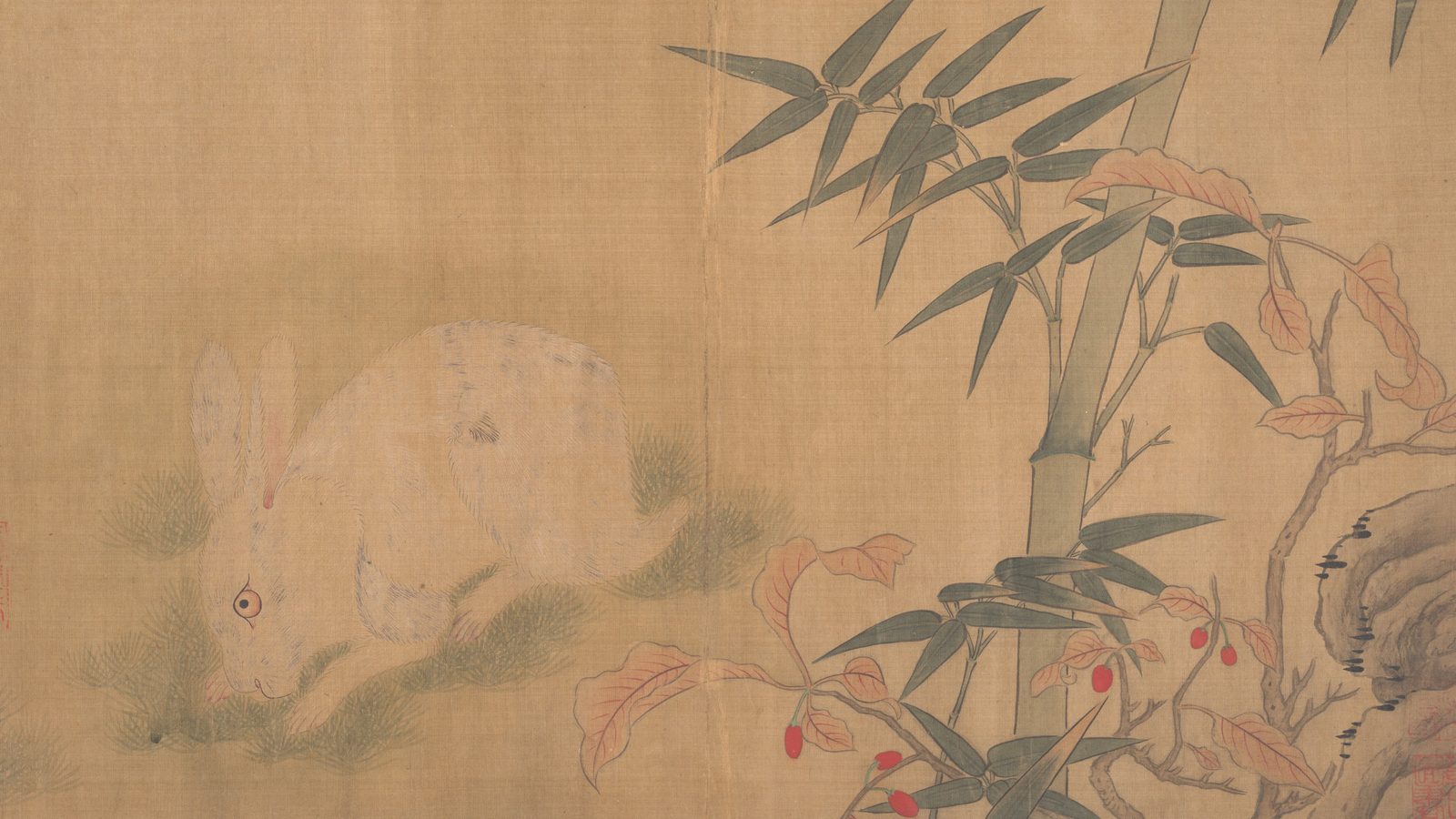
Key takeaways (~30 sec)
- The Rabbit is one of the six branches the compendium sorts as yin, on the grounds that its animal has paired feet. Because a yin branch can only take a yin stem, the five rabbit years cycle through 乙丁己辛癸 and never touch a yang stem. The classical tables pair Mao, the Rabbit, with Xu, the Dog, in six harmony; its three-harmony ring is Hai–Mao–Wei — with the Pig and the Goat; it clashes with You, the Rooster, and is harmed by Chen, the Dragon.
- Its six named relations are split three and three, and it is the only branch whose clash is the subject of a question the compendium asks and then answers by denying its own animal logic: metal should beat wood, so why does the rooster not peck the rabbit.
- Where a Rabbit year begins is three readings, not two. The Hong Kong Observatory's tables put the two start lines fourteen days apart in 1939, two days apart in 1951 and thirteen days apart in 2023, with the order flipping.
- Of the sixty branch-and-stem combinations the cycle allows, this site's survey found twenty-one in use. The Rabbit's five forms are in none of them — it shares the empty column with the Goat.
- That is a statement about a 499-line sample, not about the world, and the Rabbit's demand is otherwise high: it is the busiest animal in the family with no element pairing anybody typed.
The short answer
The Rabbit is the fourth of the twelve Chinese zodiac animals — 卯, the branch that runs from 05:00 to 07:00. Its years are 1927, 1939, 1951, 1963, 1975, 1987, 1999, 2011, 2023 and 2035. It clashes with the Rooster, and its six named relations split three and three — half allies, half conflicts.
One thing this page can state from its own survey: of the sixty branch-and-stem combinations the cycle allows, the Rabbit's five forms were typed into a search box none of the 499 suggestions sampled. That is a fact about a sample, not about demand.
Your birth date tells you which Rabbit year you belong to and which stem it carried. The rest of this page works from the rules instead: the six relations, the wood frame, and the one stem the branch holds.
The 1987 Rabbit year — a lunar year that carries its sixth month twice — has its own page.
The column with nothing in it
A stem and a branch can only share a year if they have the same parity, so each branch takes five stems and no more. Twelve branches times five stems is sixty combinations, and sixty is all this cycle can produce.
This site surveyed its own search suggestions once, on 2026-10-06, over two seed phrases and 499 suggestion lines. Twenty-two of those lines named an element and an animal together, and merging the one alias in the set — golden and metal name the same stem — those twenty-two lines land on twenty-one of the sixty combinations.
| Animal | Combinations found |
|---|---|
| Snake | 3 |
| Horse | 3 |
| Dog | 3 |
| Tiger | 2 |
| Dragon | 2 |
| Monkey | 2 |
| Rooster | 2 |
| Pig | 2 |
| Rat | 1 |
| Ox | 1 |
| Rabbit | 0 |
| Goat | 0 |
Two rows are empty, and this page is about one of them. The Rabbit's five forms are exactly as computable as anyone else's, and not one of them appears anywhere in the record. That is a statement about a sample of 499 lines and not about the world: it says nobody in those records asked for these forms, which is weaker and more honest than saying the forms do not exist. What it does mean is that a page about the Rabbit cannot lean on the usual material. The survey itself is worked through on its own page. So the rest of this page goes back to the rules: the six named relations the branch sits in, its place in the wood frame, and the one stem it holds.
The animal the book counts as even
The compendium's chapter on why the branches have animals spends its first half sorting the twelve by their feet. Six of them are yang, it says, because 六獸之足皆雙 is not a phrase that applies to them — an odd number of toes, so an odd creature. The other six, and the Rabbit is one, have paired feet, which makes them yin.
That classification is the reason this page's years behave the way they do. A branch and a stem only meet in the same year when they agree in parity, so a yin branch can only ever carry a yin stem. Rabbit years therefore cycle through 乙, 丁, 己, 辛 and 癸 — only the five yin stems, never a yang one — and those five are the five element forms the table further down lists.
The chapter is not comfortable with its own scheme, and says so in the same passage. It notices that the snake has no feet at all and has to explain why the branch is still even, and it ends by testing the element logic against the animals and finding it does not hold: the creatures of the twelve, it concludes, do not answer to one another by elemental temperament. This page reports the classification because it is what fixes the stems, and reports the doubt in the same breath.
Rabbit Compatibility: Six Relations, One Graded in Both Directions
Every branch sits in five kinds of named relation, and the Rabbit's row is split evenly: three partners on its side and three against.
- Six Harmony: Dog
- Three Harmony: Goat, Pig
- Clash: Rooster
- Harm: Dragon
- Punishment: Rat
- Self-punishment: none
The Six Harmony is the pair the compendium spends the most words on, and it derives the pair arithmetically rather than by listing it. Each branch is given a number from one to six and pairs are chosen so that the two numbers add up: 卯為四陽,戌是五陰,四五得九數, four plus five gives nine, which the chapter calls 陽數極, the limit of the yang number. Only two pairs come to three instead, and the Rabbit's is not one of them.
The second half of that chapter quotes an older book giving one verdict per pair — and grading the two directions separately. On this pair it reads 戌合卯福虛,卯合戌福厚: the same two branches, read from the Dog's end and from the Rabbit's end, and two different verdicts. This page records the sentence because it is concrete, and does not adopt either half of it. The Dog's page reads the same pair from the other end and finds the sources disagreeing there too, in a different place.
The middle of the wood frame
Four triangles divide the twelve branches, one per element, and the chapter on the Three Harmonies explains what the three positions mean before naming any of them: 生即產,旺即成,庫即收 — birth produces, the peak completes, the storehouse gathers up. The wood triangle is 亥卯未, the Pig and the Goat at the outer positions and the Rabbit between them.
Read that way, the Rabbit is the middle of that frame: the point of completion rather than of beginning or storage. The same holds for the other three triangles, whose middle positions are 子, 午 and 酉 — the four cardinals, which are also the four branches the almanac's scoring table puts all twenty of its points on a single stem for. The frame groupings do not put the Rabbit in charge of anything, and this page does not treat them as if they did; what they do is fix where the branch sits when a chart is read, which is the reason the three-harmony rules exist at all.
The one punishment with two members
Three sets of branches punish one another, and the chapter on punishments derives each by counting the ring to ten rather than by listing it: 故數自卯順至子,子逆至卯,極十數而為無禮之刑 — count ten positions from this branch in each direction and you arrive at the Rat, and the pair is named the punishment of no propriety.
It is the odd one out among the three. The other two sets have three members each, so the chapter's whole system produces seven unordered pairs and one of them is this one, with two members and no third. The chapter explains the name twice over. Water generates wood, so the Rat is the mother of the Rabbit and the two punish each other; and 卯為日門, the Rabbit is the gate of the sun, with 日出於卯 — the sun rises there — so the two stand at right angles with no order of seniority between them. The second explanation is also the clearest statement in the sources that 卯 holds 乙 alone: 卯中獨用乙木,乙用庚金為夫星而死於子,所以卯刑子.
The chapter then rules on the four cardinals as a group and finds that only one pair among them punishes: 子午卯酉有子卯互相刑,內有午酉無刑. The Horse and the Rooster are the other two of the four, and both of them are left out on this side — they punish themselves instead. So the four branches that share the almanac's single stem and the chapter's two-stem month list are also the four that split two and two on punishment.
Read your sign and element — freeThe hour the sun comes up, and the month that starts spring
Two clocks put the Rabbit somewhere. The double-hour is the second one, and the classical reason for it is the one given above: 日出於卯, the sun rises at this branch. China's science popularisation platform gives the entry as 05:00 to 07:00, matched to 卯, with the animal association written out as the rabbit, and records that this is also where an ordinary Chinese word comes from: officials counted the roll at this hour from the Tang dynasty on, and 点卯 has meant reporting for duty ever since.
The month is the other clock. Months are numbered from the Tiger, which makes the second month 卯 and the chapter on the hidden stems open its entry with 二月建卯. The same chapter puts that month at the opening of spring, and the county government page that lists the animals against their hours describes this one as the hour when the light has come and the rabbit is out of its burrow.
Neither clock is a statement about a person. The Rabbit is the fourth of twelve double-hours and the second of twelve months, and both numbers fall out of the ring; this page does not turn either of them into a claim about anyone.
The harm that calls the wood a peak
The Rabbit's harm is with the Dragon, and the chapter on harms names this pair with a mechanism rather than a verdict: 卯以旺木凌辰死土,此以少凌長相害. This branch is wood at its peak; the Dragon is dead earth; and the chapter calls the result the younger invading the elder. The sentence that follows puts the damage on the Dragon's side — 故辰見卯,而卯更帶辰干真鬼則其害尤甚 — so on this pair the chapter's direction runs opposite to the one it gives elsewhere.
The chapter also supplies the machinery behind all six harms: you fear being clashed, and a third branch is what combines with the one that clashes you. On this branch's line the chain reads 卯畏酉沖,而辰合酉. So the Dragon is not the Rabbit's enemy in this account so much as the branch holding the Rooster. The Dog's page quotes the same sentence from the Rooster's side, where the names are reversed, and explains the general machinery there.
The clash, and the question the compendium asks about it
The Rabbit's clash is with the Rooster, seven positions round the ring, and the chapter on collisions makes an exception for these four branches at the top: for 子午卯酉, the chapter says, a same-element opposition 反成大格,不以衝擊論 — it forms a structure of its own rather than counting as a collision.
The chapter's one illustration of a same-stem collision uses this pair by name: 若同類相衝,如甲子見甲午,己卯見己酉之類,主多破祖業,平生心不閒,剛明有斷,假令祿高名重,終有一失. 己卯 is 1939 and 1999; the counterpart years in the illustration are 己酉, 1969 and 2029.
What makes this pair worth its own section is a question the compendium asks about it, in a different chapter, and then answers against itself: 金勝木,雞何不啄兔 — metal masters wood, so why does the rooster not peck the rabbit. The chapter's own reply is that the animals do not answer to one another by element at all, and that what decides these contests is teeth and claws. So the clash is a relation on the ring, and the book is explicit that it is not a claim about a rooster and a rabbit in a yard. This page keeps that distinction: the pairing chart records the relation, and neither this page nor that one reads it as animal behaviour.
Ten Rabbit years, and a column of noes
Rabbit years arrive every twelve years. Between 1927 and 2035 there are ten of them.
| Year | Branch | Form | Record |
|---|---|---|---|
| 1927 | 丁卯 (ding-mao) | Fire Rabbit | nothing in the record |
| 1939 | 己卯 (ji-mao) | Earth Rabbit | nothing in the record |
| 1951 | 辛卯 (xin-mao) | Metal Rabbit | nothing in the record |
| 1963 | 癸卯 (gui-mao) | Water Rabbit | nothing in the record |
| 1975 | 乙卯 (yi-mao) | Wood Rabbit | nothing in the record |
| 1987 | 丁卯 (ding-mao) | Fire Rabbit | nothing in the record |
| 1999 | 己卯 (ji-mao) | Earth Rabbit | nothing in the record |
| 2011 | 辛卯 (xin-mao) | Metal Rabbit | nothing in the record |
| 2023 | 癸卯 (gui-mao) | Water Rabbit | nothing in the record |
| 2035 | 乙卯 (yi-mao) | Wood Rabbit | nothing in the record |
The last column is the one that separates this page from a list of dates, and it is empty all the way down. This site's survey knows none of the Rabbit's five forms, so every row reads the same; that uniformity is the point, and it is the same fact the table at the top of this page shows as a zero. The forms are spread evenly across the window for a reason worth stating: ten years is two full turns of a ten-stem cycle, so each of the five appears exactly twice, and the arithmetic behind the column is not a choice — a branch step of twelve against a stem step of ten advances the stem by two each time, and a yin branch can only take the five yin stems.
Where a Rabbit year begins is a separate question with three answers rather than two, and China's calendar standard settles the most official one. GB/T 33661-2017, drafted by the Purple Mountain Observatory and in force since September 2017, puts the animal's year on the first lunar month. Chart reading draws the line at Li Chun instead, and three Rabbit years from the Hong Kong Observatory's tables show how far apart the two lines can get: fourteen days apart in 1939 and thirteen days apart in 2023, with the lunar year first the second time and Li Chun first the first — and only two days apart in 1951, which is as close as the two lines come. Both observatory tables head those years year of the Rabbit, the same words this page uses. How this site handles sources sets out the rest, including the difference between a text the page is quoting and a conclusion the page is drawing itself.
What 卯 holds: one stem, or two
The almanac page that lists the hidden stems carries a verse for the whole set, and this branch's line in it is the shortest of the twelve: 卯中乙木獨相逢, wood and nothing else. The same page explains why, sorting the twelve into four groups and putting this one among the four cardinal branches, whose entries are the 臨官 positions of their stems — 卯為乙木之臨官,故藏乙木. Its scoring table then gives every branch twenty points, and gives this one a single line: 卯:乙木 20分. Three of the twelve branches get that treatment, and they are 子, 卯 and 酉 — pure water, pure wood and pure metal, with fire and earth never getting one.
Against that, the Ming chapter that parcels out the month rather than the branch fills the same thirty days with two stems instead of one: 二月建卯,卯中有甲木用事七日,乙木二十三日. Seven days of 甲 and twenty-three of 乙. This is a different question from the almanac's — what rules the month, not what the branch holds — and unlike the Dog's cell, where the sources put two different fire stems under the same branch, the two lists here agree on which stem dominates. Twenty-three days out of thirty, and twenty points out of twenty, are both 乙. They disagree only about whether 甲 belongs in the list at all.
One thing does line up exactly. Four branches get only two stems in that chapter's month list — 子, 卯, 午 and 酉 — and those are the same four the almanac's scoring table and the punishment chapter keep separating out. This site's own engine reads 卯 as holding 乙 alone, and its hidden-stem counts for the twelve run 1, 3, 3, 1, 3, 3, 2, 3, 3, 1, 3, 2; the Rabbit shares its single stem with the Rat and the Rooster. The Rat's page works through the same fork on the water side, where the two readings are harder to reconcile.
Where this page can be wrong
Four places, stated plainly.
The survey comes first, because the opening section rests on it. Twenty-two suggestion lines out of four hundred and ninety-nine is a small sample, drawn from two seed phrases on one day, and a different sample would move the numbers; the one thing the arithmetic fixes is that sixty is sixty, and that twenty-one of them being in use leaves thirty-nine that are not. The Rabbit's zero is a fact about those records and nothing more.
The counts come second. That the Rabbit's row splits three and three, that its set of punishments is the only one with two members, that its harm is the one the chapter describes as peak wood against dead earth — these are read off a fixed twelve-member ring and the ring is not in dispute, but the sentence that says the punishment set is the odd one out is this page's, not a source's.
The verdicts come third, and they are the ones most likely to travel further than they should. The directional reading of the Six Harmony, the direction of the harm sentence, the collision chapter's exception for the four cardinals: all three are reported because they are concrete and checkable, and none is adopted. They are one Ming author's readings of a chart, and the chapter on animals, which is the one that asks whether a rooster pecks a rabbit, is the best evidence available that this material should not be read as animal behaviour.
The window comes last. Ten years is a choice this page made, and it is the reason each form appears exactly twice; a window of a different length would give a different column, though the empty column would survive any window, since the survey is what is empty and not the cycle. And the two start lines are given for three years rather than a rule, because the gap between them runs from two days to two weeks and there is no typical case to quote.
GPTbazi is a personality map for entertainment and self-reflection. It is not medical, legal, financial, or psychological advice, and it is not a prediction of events. This page counts combinations and reads what the sources say about them; it does not forecast outcomes for people.
Sources
- Sanming Tonghui (三命通会), juan 2, 'On the Animals of the Branches' (論地支屬相) — the pairings are written out in one line (故子屬鼠,丑屬牛…卯屬兔…亥屬豬), and the chapter then sorts the twelve by their feet: the yin six are 牛、兔、蛇、羊、雞、豬 because 六獸之足皆雙, with an aside about the snake having no feet at all. It also tests its own five-element scheme against the animals and reports where the scheme fails, asking of this branch directly: 金勝木,雞何不啄兔 — metal should master wood, so why does the rooster not peck the rabbit — before concluding that 十二辰之禽以氣性相克則尤不相應, that the creatures of the twelve do not answer to one another by elemental temperament
- Sanming Tonghui (三命通会), juan 2, 'On the Human Element in Charge' (論人元司事) — the chapter parcels each month out day by day, and the second month is given as 二月建卯,卯中有甲木用事七日,乙木二十三日, seven days and twenty-three days, which is the whole month. Running the same list across all twelve shows that exactly four branches get only two stems, and those four are 子午卯酉
- Sanming Tonghui (三命通会), juan 2, 'On the Six Combinations of the Branches' (論支元六合) — the chapter assigns each branch a number from one to six and pairs them so that the sums come out; this pair is given as 卯為四陽,戌是五陰,四五得九數, and the chapter notes that while 子丑 and 午未 come to three, 余皆得九者,乃陽數極也. The second half quotes the Tianyuan Bianhuashu (《天元變化書》) giving one verdict per pair, and grading the two directions separately: 戌合卯福虛,卯合戌福厚
- Sanming Tonghui (三命通会), juan 2, 'On the Three Harmonies of the Branches' (論支元三合) — a frame is explained as birth, peak and storehouse in one line (生即產,旺即成,庫即收) and the wood frame 亥卯未 is named among the four, with this branch as its middle member. The chapter adds that the four frames leave earth out (五行不言土者,四行皆賴土成局) and that if all four earth branches are present they form a frame of their own
- Sanming Tonghui (三命通会), juan 2, 'On the Six Harms' (論六害) — 卯辰相害者,謂卯以旺木凌辰死土,此以少凌長相害: this branch is described as wood at its peak and the Dragon as dead earth, and the harm is named for the younger invading the elder. The chapter goes on that 故辰見卯,而卯更帶辰干真鬼則其害尤甚, which puts the damage on the Dragon's side. It then gives the mechanism behind the whole set of six — a branch harms you because a third party has combined away the one you fear — and on this branch's line the chain reads 卯畏酉沖,而辰合酉
- Sanming Tonghui (三命通会), juan 2, 'On the Three Punishments' (論三刑) — this set is reached by counting the ring to ten in both directions (故數自卯順至子,子逆至卯,極十數而為無禮之刑) and is named the punishment of no propriety. The chapter gives two reasons for the name: water generates wood, so 子 is the mother and 卯 the child and they punish each other; and 卯為日門,子為陽之所生,日出於卯,子卯角立,無欽卑之道. It then supplies the stem-level mechanism — 卯中獨用乙木,乙用庚金為夫星而死於子,所以卯刑子 — which is also the clearest statement in the sources that 卯 holds 乙 alone. Finally it rules on the group: 子午卯酉有子卯互相刑,內有午酉無刑
- Sanming Tonghui (三命通会), juan 2, 'On Collision' (論衝擊) — the chapter opens by making an exception for the four cardinal branches, saying that for these 反成大格,不以衝擊論 rather than treating the opposition as a collision, and it later names a same-stem collision with this branch in the illustration: 若同類相衝,如甲子見甲午,己卯見己酉之類,主多破祖業,平生心不閒,剛明有斷,假令祿高名重,終有一失
- Hanyu Dictionary almanac (漢典黃曆), 'The hidden stems of the branches and the distribution of the five elements' — carries the hidden-stem verse (卯中乙木獨相逢), sorts the twelve into four groups with a reason for each, and says of the four cardinal branches that 卯為乙木之臨官,故藏乙木. Its scoring table gives every branch twenty points and gives this one a single line, 卯:乙木 20分, so the whole score sits on one stem
- China Science Communication (科普中国, China Association for Science and Technology), entry on 卯时 — the double-hour is given as 5 to 7 in the morning, matched to the branch 卯, with 生肖关联为兔, and its element is given as wood. The entry also gives the administrative history of the hour: 自唐代起形成點卯制度,官員須於卯時到官署簽到,衍生出應卯、畫卯等流程,點卯一詞至今仍作為報到的代稱沿用
- China Science Communication (科普中国, China Association for Science and Technology) — the twelve double-hours one by one: 卯时 is listed as 5:00 to 7:00, with the note that this is the hour for 日出而作 and that officials counted the roll at this hour, which is where 点卯 comes from, and with Li Bai quoted for the dawn
- People's Government of Duchang County (都昌县人民政府, Jiangxi), page on the twelve animals — gives the pairing of each animal with a double-hour and, for this one: 清晨五點至七點,屬卯時。天剛亮,兔子出窩,喜歡吃帶有晨露的青草,故為卯兔. The page also carries the standard twelve-animal sequence
- National Public Service Platform for Standards Information (国家标准信息公共服务平台) — the record for GB/T 33661-2017, Calculation and Promulgation of the Chinese Calendar: recommended national standard, drafted by the Purple Mountain Observatory of the Chinese Academy of Sciences, released 2017-05-12, in force from 2017-09-01, last re-checked 2023-12-28 (上次复审) and continued in force
- Guangming Online (光明网, 2024-02-08), carrying a Guangzhou Daily feature — the national standard GB/T 33661-2017 is quoted by number and date, with its rule spelled out: 每年的正月初一到第二年的除夕为计算生肖(属相)起止日; the astronomer Zhao Zhiheng of the Tianjin Astronomical Society is quoted saying the animal is counted from the first day of the first lunar month rather than from Li Chun
- Guangming Online (光明网, 2024-04-09) — quoting Wang Kechao, head of science communication at the Purple Mountain Observatory: the ten stems and twelve branches combine into sixty terms beginning at 甲子; the months were marked with branches, taking the lunar month containing the winter solstice as 子月, the twelfth as 丑月 and the first as 寅月
- Hong Kong Observatory — Gregorian-Lunar Calendar Conversion Table of 1939, headed 'Ji-mao – year of the Rabbit': Spring Commences falls on 5 February and the first lunar month begins on 19 February
- Hong Kong Observatory — Gregorian-Lunar Calendar Conversion Table of 1951, headed 'Xin-mao – year of the Rabbit': Spring Commences falls on 4 February and the first lunar month begins on 6 February
- Hong Kong Observatory — Gregorian-Lunar Calendar Conversion Table of 2023, headed 'Gui-mao - year of the Rabbit': the first lunar month begins on 22 January and Spring Commences falls on 4 February
- GPTbazi — how this site reads a chart